

Amy Webb knows how to put on a show.
Her annual keynote at SxSW has become one of the most anticipated events in the futures industry. For 18 years, her Emerging Tech Trend Report has accompanied that keynote, and the report itself reaches a global audience well beyond the conference hall.
This year, she opened with a funeral. A custom-written song, a eulogy for the old Trend Report, complete with a marching band to welcome its successor: the Convergence Outlook.
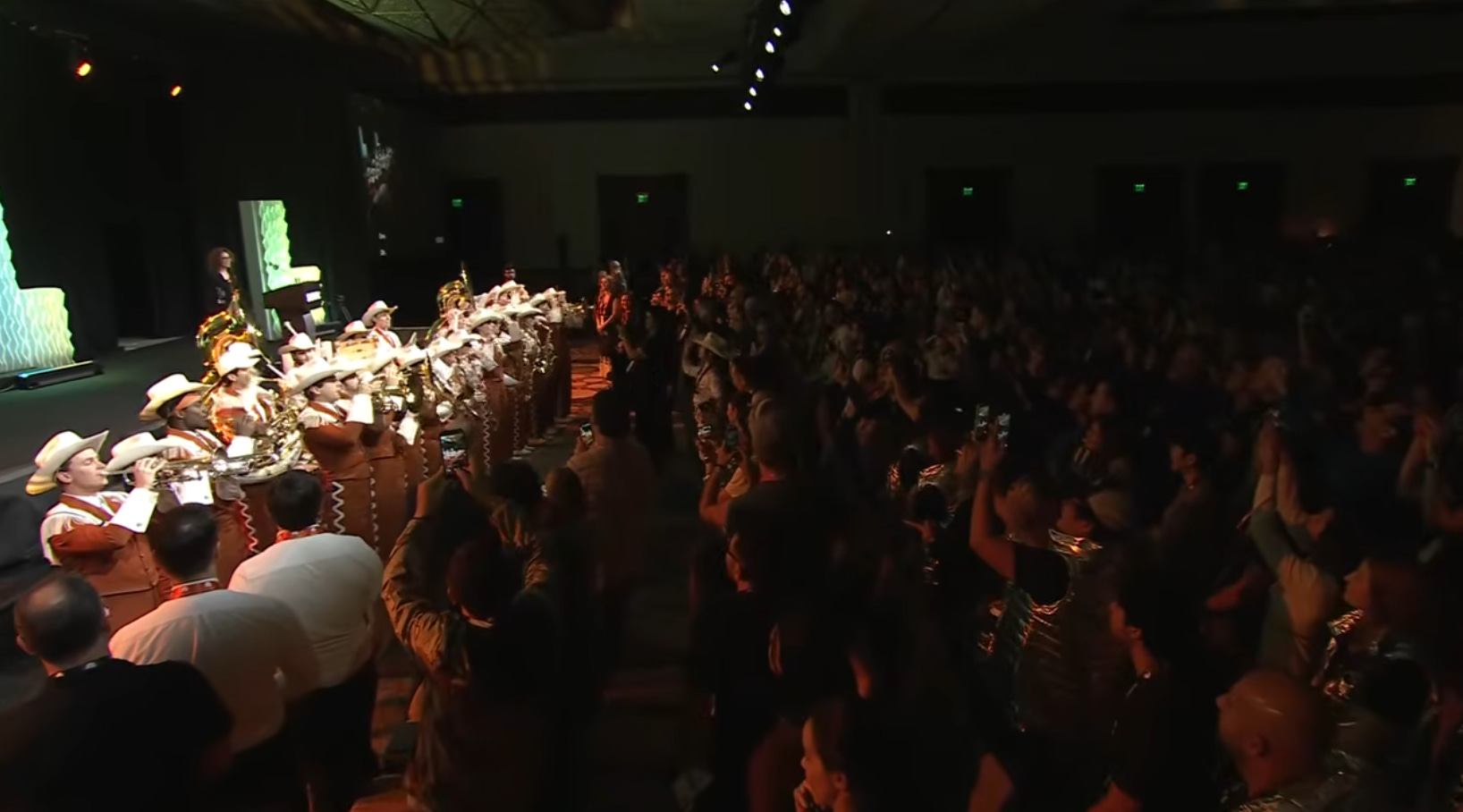
I watched the full keynote. Not for the predictions. I wanted to understand something else: the way she invokes the future. How she uses language, the metaphors she chooses, and what assumptions she bakes into her framing. Because the implicit promise of foresight is to provide orientation: to surface hidden assumptions, open possibility spaces, and prepare for multiple futures. And I was curious whether the world's most prominent futurist delivers on that promise or whether she is doing something else.
The Storm Metaphor
The central metaphor of Webb’s 2026 keynote is the storm. She uses the word 24 times across 10,700 words. Capitalism is a “perpetual storm.” A convergence is “a storm system.” And the core message built around this metaphor is clear:
“This perpetual storm, it doesn’t care about you, which means that you have to care about the storm before it arrives.”
The metaphor is doing real work here. She arrives at it through Schumpeter’s concept of creative destruction, and the choice is precise. A storm is a destructive natural phenomenon. It tears down what stands, levels structures and leaves wreckage. “Each new wave wipes out the last one,” she says. New technologies “can make you irrelevant overnight.”
The future, in this framing, is something that destroys the status quo and moves on without looking back. Nobody caused it; nobody controls it. You can prepare for it and survive it. You do not shape it. The only reasonable response to a storm is readiness.
She reinforces this through a carefully constructed upgrade narrative. The old Trend Report, she explains, tracked individual trends. Useful, but limited. “Trends are kind of like weather data,” she says. “None of us are looking at a number on a barometer as a clue that we should evacuate town, right?” For that, you need a meteorologist. You need someone who can read the storm.
“So this is actually not just a eulogy for our trend report,” she tells the audience. “It’s for all trend reports.”
She buries the entire category. And in its place, she introduces convergences: phenomena that, in her framing, require her specific methodology to detect. “We built a storm tracker. We have invented a brand new methodology.” The intellectual upgrade feels natural. Of course you need a storm tracker, not a thermometer. But the consequence is that the old tool was available to everyone. The new one is available only from her. 1
The Language of Certainty
The framing goes deeper than metaphor. I ran a linguistic analysis of the full transcript. Webb uses language of certainty (will, going to, inevitable, always, never) at a ratio of 11.4 to 1 compared to language of possibility (could, might, maybe, what if). She says “I don’t know” exactly three times. She never says, "It depends.” She never says, “It remains to be seen.” She never uses the word “alternative.” 2
In her telling, the future is certain. It is not a space of multiple possibilities. It is a specific trajectory, already in motion, that you are either prepared for or you are not. The only uncertainty she permits is personal: Will you be ready? Will your company act in time? The message is clear: the future is decided; the only open question is whether you keep up.
At one point, she says it plainly: “After I scare the hell out of you, you are going to feel energized.”
A Narrative, Not an Analysis
Webb is not analyzing futures. She is constructing a specific future narrative. Every element of her keynote, from the storm metaphor to the certainty of her language to the theatrical funeral for the old format, serves a single story: the future is a force of nature, it is already here, and you need her tools to survive it.
Webb’s engagement with these topics is clearly genuine, and many of the technological developments she describes are real phenomena worth watching. The question is not whether they matter. The question is what happens when they are packaged into a single, deterministic narrative.
Education technology critic Audrey Watters once observed, “The best way to predict the future is to issue a press release.” But that only works if futurists play along. Webb’s evidence follows that logic precisely. Press releases and prototypes are treated as confirmed trajectories. Pilot projects become established realities. The narrative is the deliverable.
The patterns beneath that narrative are familiar. In my work deconstructing futures presentations, I keep running into the same four rhetorical tropes:
The deterministic future. “This is simply what’s coming. There is no alternative.” Webb’s entire storm framing operates here. Convergences “become inevitable before they look inevitable.” The future is not a possibility. It is a schedule.
The revolutionary break. “Everything you know will soon be obsolete.” Convergences “rewrite who wins.” The message: your world is ending, whether you notice or not.
Technology as savior. In Webb’s version, the savior is not the technology itself but her framework for understanding it. The Storm Tracker, the Convergence Outlook, and the proprietary methodology. The rescue comes not from building something, but from buying the right tool.
The warning to laggards. “Nobody’s coming to save you.” “Are you going to get left behind? Spoiler alert, you are.”
Webb deploys all four.
Seismograph and Amplifier
The future as an uncontrollable force bearing down on us, technology as destiny, humans as passengers. This is the dominant future narrative of our time. And when she chooses exactly this story, she reveals something intriguing: she is mirroring how her audience already perceives the future.
Her keynote is a seismograph for the prevailing mood. A room full of executives and decision-makers cheers loudest when she channels their frustration at a system they feel powerless to change. That reaction tells you something. Not about technology, but about the emotional state of the people who are supposed to be shaping the response to it. The narrative she constructs lands because it matches the anxiety that is already there. She is not creating the fear. She is giving it a stage, a vocabulary, and a product catalog.
The problem is that she does not treat it as one future narrative. She reinforces the dominant narrative instead of making it visible, naming it as one possible framing among many, and opening the conversation to alternatives. She amplifies it. Every keynote, every report, and every Storm Tracker is a feedback loop that solidifies the narrative further. Sohail Inayatullah describes the core task of critical futures work as “loosening the future.” 3 Making rigid narratives flexible again, opening space for alternatives, and reminding us that no single trajectory is inevitable. Webb does the opposite. She tightens.
Stories about the future shape action in the present. They make certain futures more likely and others harder to imagine. A futurist who reinforces the dominant narrative is narrowing the field of vision.
Watch how she closes. She channels the audience’s frustration into a rant about 250 years of selfish capitalism, political systems that reward outrage over governance, and powerful people making decisions out of ego. The room erupts. Standing ovation. Then the pivot: “But anger isn’t a plan. Anger is a distraction.” And the distraction lifts to reveal the product. Download the power folder. Visit the website. Buy the book. The last words she leaves them with: “Every civilization that has ever mattered was built by people like us.” The audience walks out energized. But the question is whether they know what to do next.
Further Reading
Trend Talks vs. Futures Literacy: My longer analysis of why typical trend presentations overwhelm rather than empower, the psychological mechanisms behind them, and five principles for building actual futures competence.
From Future Narratives to Actionable Insights: The four rhetorical tropes referenced in this article, plus five questions for deconstructing any futures narrative you encounter.
That analyzing how trends interact rather than in isolation is presented as a brand-new invention is worth a footnote of its own. I and many others in the foresight community have argued for a long time that analyzing isolated trends is futile and needs systemic, cross-domain analysis. The concept is not new. The proprietary branding is.
There is a certain irony to a US-based futurist projecting this level of certainty about the future while the current US administration is arguably the single largest source of global uncertainty right now. Webb only vaguely points in that direction once. When she addresses economic disruption and potential political extremism, she frames it explicitly as driven “not because of policy, not because of protectionism, but because of physics.” The biggest uncertainty factor of 2026 is absent from her analysis. The storm, it seems, has no political weather system.
Yes, I'm repeating this concept. It is the single most useful lens I have found for understanding what critical futures work could do.
Can't stand Webb and her "quantitative futures," so thank you for this. My comment on futurists like this is always: If someone says "in the future you will..." they're selling something. In her case, it's her latest consulting vehicle.
She needs to read Maggie Jackson's book.
The main problem I had with the likes of Sam Altman and company is their futures cone was described as a single line. That betrays a deterministic desire, not an evolving potential within an interconnected, complex ladder of adjacent possibles.