

As a futurist, I sometimes get asked whether I am an optimist or a pessimist about the future. My answer is usually “neither.” Both options share the same underlying assumption: that the future is already decided.
The optimist does not look at a situation and weigh the possibilities. The optimist already knows it will work out. The pessimist does not assess the evidence and conclude that things look grim. The pessimist already knows it will go wrong. Neither of them is making a judgment. Their disposition determines the outcome in advance, regardless of what is actually happening. And that is the problem: if the future is already settled, then nothing you do can change it. Both positions are fundamentally deterministic. Both make action irrelevant.
But the future is not settled. Futures, as the German philosopher of technology Armin Grunwald has argued, are constructs that exist only in the present: linguistic expressions composed of knowledge, assumptions, values, and interests. They are ideas about what might come, shaped by what we believe, what we fear, and what we want. That means they are open. Contested. And, crucially, shapeable.
I have been thinking about this for a while, because the same logic applies to how we talk about utopia and dystopia. We tend to treat them as descriptions of the future: utopia is the good ending, dystopia is the bad one. But that is not what they were invented for. Utopias were always meant to be mirrors held up to the present, showing what’s missing, what could be better, what we should work toward. Dystopias were warnings: this is where we end up if we do not change course. Both are tools for action. Both exist to make us do something.
We have degraded them to forecasts. And that is the trap.
Currently, the dystopian forecast is winning. The collapse narrative has become the default assumption about where things are headed: not a scenario to be examined, but the background understanding of the West.1 Climate destabilization, democratic backsliding, technological disruption, rising inequality—the problems are real. The question is what we do with them. And increasingly, the answer seems to be, “Assume the worst and hope for the best.” Collapse narratives have become self-fulfilling in this way. The more people treat collapse as inevitable, the more they withdraw from the systems that could prevent it.
So what do we do? The standard response is predictable: we need more utopias. More positive visions. More hopeful stories about the future.
I understand the impulse. And I think it misses the point.
Why utopias will not save us
Three factors currently undermine the call for utopias.
First, the word itself has become an insult. Call an idea “utopian” and you have dismissed it. The great utopian projects of the 20th century, from Soviet communism to the neoliberal promise of universal prosperity through deregulation, did not end well. Utopia now means “disconnected from reality.” Hard to build a movement on a word that makes people roll their eyes.
Second, every utopia carries a shadow. Who is allowed to define the ideal society? What happens to those who disagree? Utopias tend to be exclusive (who belongs?), elitist (who decides?), and in their worst forms, totalitarian (what about dissenters?). One person’s utopia is, quite literally, another person’s dystopia.
Third, and this is the one that matters most: the problem right now is not that we lack analysis. We can all see what is wrong. We know about climate change, inequality, and the erosion of democratic institutions. We are not short on diagnosis, and we are not short on ideas for improvement. What we lack is the will to start. The gap is not between “what is” and “what could be.” It is between knowing and doing. Between understanding the problem and actually picking up a tool.
Utopias are effective at showing us what is missing. They are not particularly adept at getting us off the couch.
Resisting dystopia
Kim Stanley Robinson’s The Ministry for the Future begins with a wet-bulb heat event in India. Millions die.2 This is not a warning about a distant future. This is an opening scene set in the near present, in a world that looks a lot like ours. And what follows is not a descent into hell and not an ascent into paradise. What follows is a group of people trying to do something about it. Clumsily, contradictorily, with imperfect tools and competing interests and no guarantee that any of it will work.
The characters argue. They fail. They make deals with people they do not trust. They use methods that are morally questionable. The progress, when it comes, is messy and partial and constantly at risk of being undone. Robinson himself has described the book this way:
“It’s not a utopian novel, because they haven’t solved the problems but have resisted dystopia.”
Resisted dystopia. Two words, and suddenly there is a third option.
Isabella Hermann, a political scientist and science fiction scholar based in Berlin, has given this third option a name and a framework. In her 2025 book Zukunft ohne Angst (“Future Without Fear,” currently only available in German, with an English edition in planning), she defines anti-dystopia through three characteristics.
It begins in the catastrophes of the Anthropocene. Anti-dystopia starts here, in a world of climate crisis, democratic erosion, and structural inequality. No sugarcoating.
It decouples catastrophe from resignation. This is the crucial move. Just because things are bad does not mean they must end in oppression or collapse. The values of justice, community, and transformation break the seemingly inevitable link between crisis and surrender. Catastrophe does not have to mean dystopia. That link is a choice, not a law of nature.
And it is inherently imperfect. There is no endpoint. No blueprint for the perfect society. No guarantee. Anti-dystopian action is contradictory, incomplete, and a continuous process of trying to make things somewhat better without knowing whether it will work. Hermann puts it bluntly: enduring these contradictions is itself anti-dystopian.
This is what convinced me. Anti-dystopia promises nothing. It does not say, “Do X, and everything will be fine.” It says something much more modest and much more honest: only if we do something is there even a possibility that things could get better.
Hermann has a line that stuck with me: if an era gets the stories it deserves, then the emergence of anti-dystopian fiction tells us something about a need in society to push back against a pessimistic view of the future. The appetite for something beyond the dystopia-or-utopia binary is already there. It just did not have a name.
What anti-dystopia looks like in practice
Anti-dystopia is more than a literary genre. It is a posture. And that posture has consequences for how we act.
Thousands of answers, not one. There is a moment in Octavia Butler’s Parable of the Sower where a student challenges the protagonist: “So what’s the answer?” She replies, “There isn’t one. I mean there’s no single answer that will solve all of our future problems. Instead, there are thousands of answers, at least. You can be one of them if you choose to be.”3
You can be one of the answers. Not find the answer, not wait for the answer. Be one. This operates at every scale. International climate policy, imperfect and contradictory as it is, counts. So does a housing cooperative in your neighborhood. The point is not to determine the right level of engagement. The point is to choose one and start.
Contradictions as feature, not bug. In Butler’s novel, Lauren Olamina founds a new belief system in the middle of societal collapse. She cannot fix the world around her. What she can do is build a small community within her means, one that allows its own premises to be questioned and challenged from within. That willingness to hold contradictions extends beyond community building. Take technology: unlike dystopias from 1984 to Black Mirror, anti-dystopia holds technology as a tool that can liberate or oppress, depending on how we choose to use it.
Acting without a guarantee. In Station Eleven, a traveling theater troupe performs Shakespeare in a world where civilization has collapsed. Their motto, painted on one of their wagons: “Survival is insufficient.” They do not perform because theater will rebuild civilization. They perform because a life worth living requires more than just staying alive.
That is anti-dystopian action at its core: doing what makes the world more human, even when you cannot prove it matters in the grand scheme. Kim Stanley Robinson put it differently when he corrected Martin Luther King’s famous line. The original says: “The arc of the moral universe is long, but it bends toward justice.” Robinson’s version: “The arc of history is long, but we can bend it toward justice.” The difference is two words, and it changes everything. We can. Agency identified. The arc does not bend on its own.4
A third movement
So here is where I end up. Dystopia or utopia. Pessimism or optimism. These feel like the only options, and they are both dead ends, because they are both fundamentally passive. They describe states of the world, and they ask you to predict which one is coming.
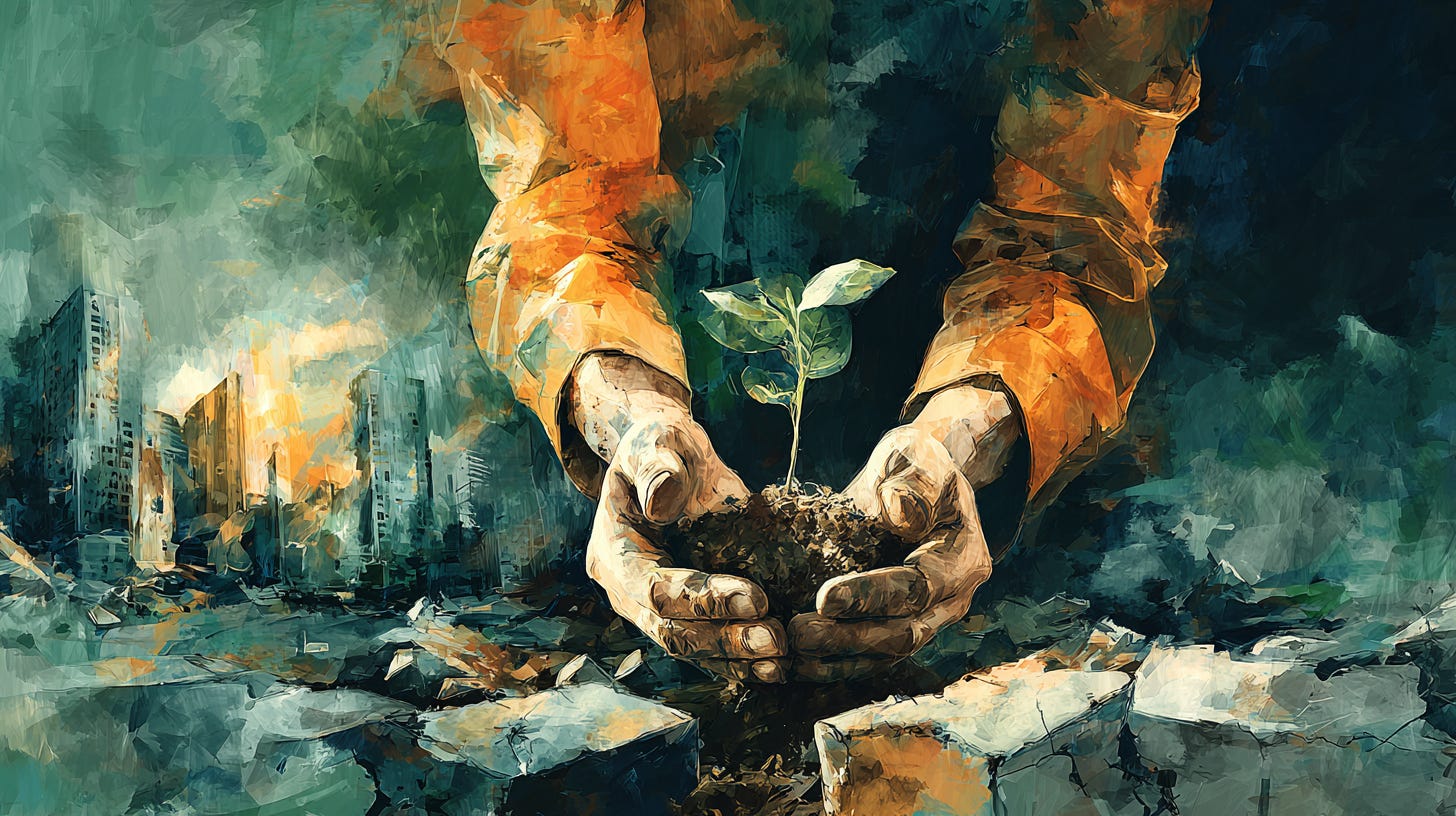
Anti-dystopia does something different. It is not a third state. It is a third movement.
Consider the alternative. A world in which everyone who has the capacity to shape things has already decided that shaping them is pointless. That alternative is not a scenario but a guarantee.
Isabella Hermann writes:
“Rebelling against the circumstances is always worthwhile. Because working for justice, community, and transformation, whether through small everyday actions or through the struggle for comprehensive social reform, is always better than doing nothing. And nobody needs to be afraid of doing the wrong thing, because anti-dystopian action is by definition an ongoing, contradictory process that has no perfect endpoint and offers no blueprint for ‘correct’ action.”5
I find that liberating. It removes the one excuse that keeps most of us stuck: the fear that whatever we do will not be enough. Of course it will not be enough. That is the point. Do it anyway.
Further Reading
Isabella Hermann: Zukunft ohne Angst (oekom, 2025). Currently in German only.
Isabella Hermann: Die Anti-Dystopie als Widerstand gegen negative Zukünfte (re:publica 25 talk video, in German).
My Garden Note on Anti-Dystopia for a longer exploration of the framework and its literary examples.
We interviewed Isabella Hermann on the Kritische Zukunftsforschung Podcast (in German) about her work on science fiction and futures.
A reader of my previous issue rightly wondered if this trend is specifically a Western phenomenon. Indeed, as Payal Arora shows in her latest book From Pessimism to Optimism, the picture looks very different in the Global South. I will pick up on that in a future issue.
It’s still the bleakest opening chapter of a book I’ve ever read. I feel almost panicked anytime a heatwave in India is mentioned in the news.
The quote appears in Hermann’s Zukunft ohne Angst (p. 79), attributed to Kim Stanley Robinson, who adapted it from a conversation in Octavia Butler’s Parable of the Sower.
Robinson made this point in an episode of the Future Histories podcast (S03E55, 2025).
Hermann, Zukunft ohne Angst, p. 95. Translation mine.
Thank you for developing and sharing this perspective, which enhanced my Easter.